Anthony Edwards · Over 26.5
SHARP SIDESTEAMThe market prices this at 44.6%. The sharps make it 49.5%. That gap is your edge.
Sharp prop betting is not a hunch. It is a repeatable process. Here is the exact five-step read good bettors run before they risk a dollar: hit rates, the game log, the matchup, the line, and the edge. Learn the method below, then let EdgeFinder run it for you on every prop on the slate.
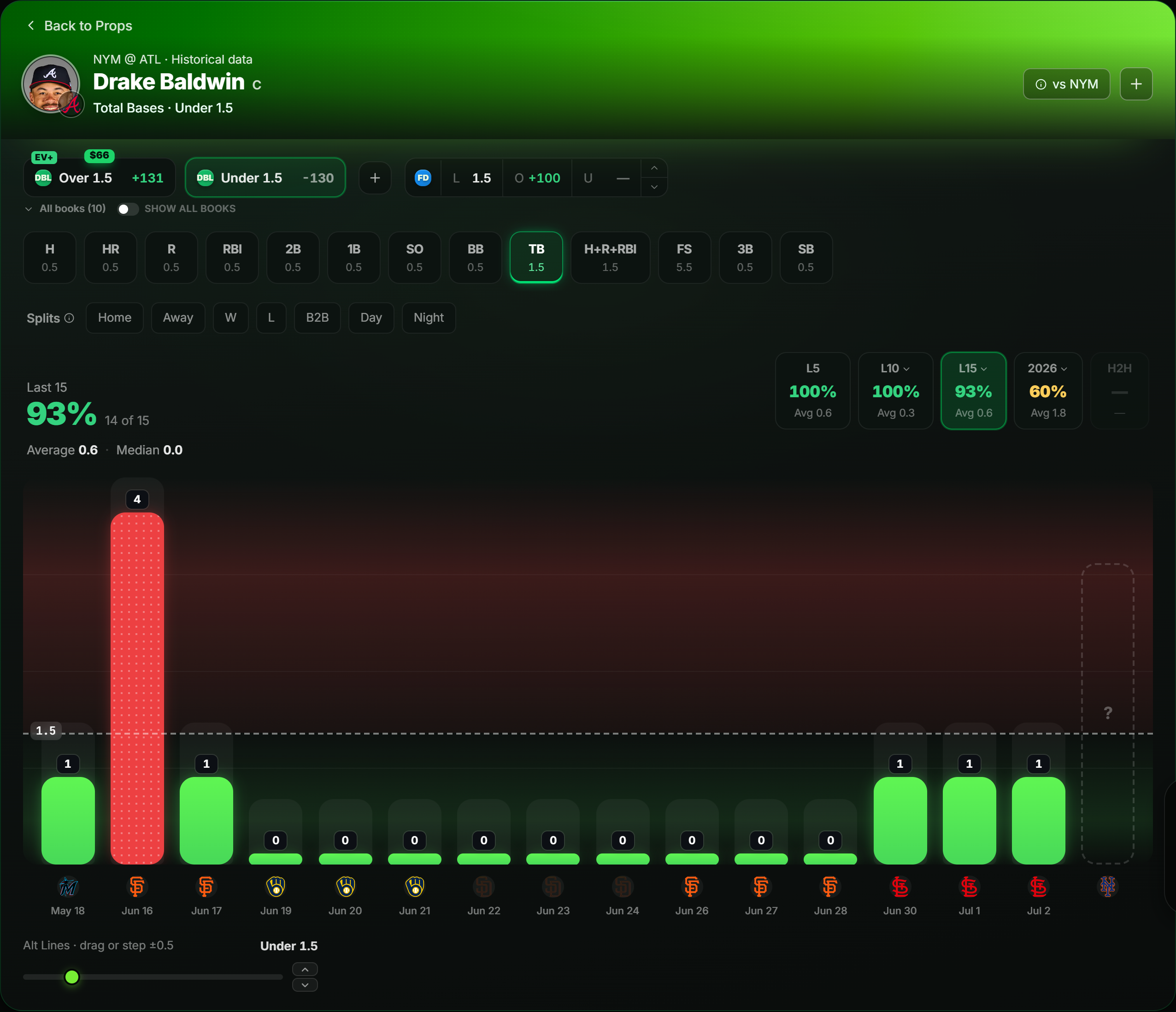
A prop is a yes/no question: does the player clear the number or not? The fastest read on that is the hit rate: how often he has gone over in his recent games. But one window alone lies. A red-hot last-5 can hide a cold season; a strong season average can bury a slump that started three games ago.
Stack the windows and read them together. And check the same across stats: a player can be a lock on points and a coin flip on rebounds. The two strips here show exactly that: the same player, two markets, very different pictures.
Averages are seductive and misleading. A 27-point average can be ten quiet 20s and a few 40-burgers, or it can be fifteen steady nights between 26 and 30. Against a 26.5 line, those are completely different bets.
Open the log and look at the shape. The game log tells you whether the number is a floor he clears almost every night or a ceiling he only touches when everything breaks right. No season average can tell you that.

Recent form happened against last week's schedule. Tonight is a new matchup, and the matchup moves the number. A guard who feasts on switch-heavy defenses can go quiet against an elite point-of-attack team.
Pace matters just as much: an up-tempo game hands out more possessions, and more possessions mean more shots, rebounds and assists to go around. A grind-it-out opponent does the opposite. Same player, same line. A different bet depending on who is across from him.
Same player, same line. A different bet depending on the matchup.
On props the number is not fixed. Every book prices it a little differently, and half a point is not cosmetic. The gap between Over 26.5 and Over 25.5 is a whole band of outcomes where you win instead of push or lose.
The price matters just as much as the line. The identical bet can pay noticeably more at one book than another, so pulling up every book and taking the best of both is free value, one of the most repeatable edges in prop betting.
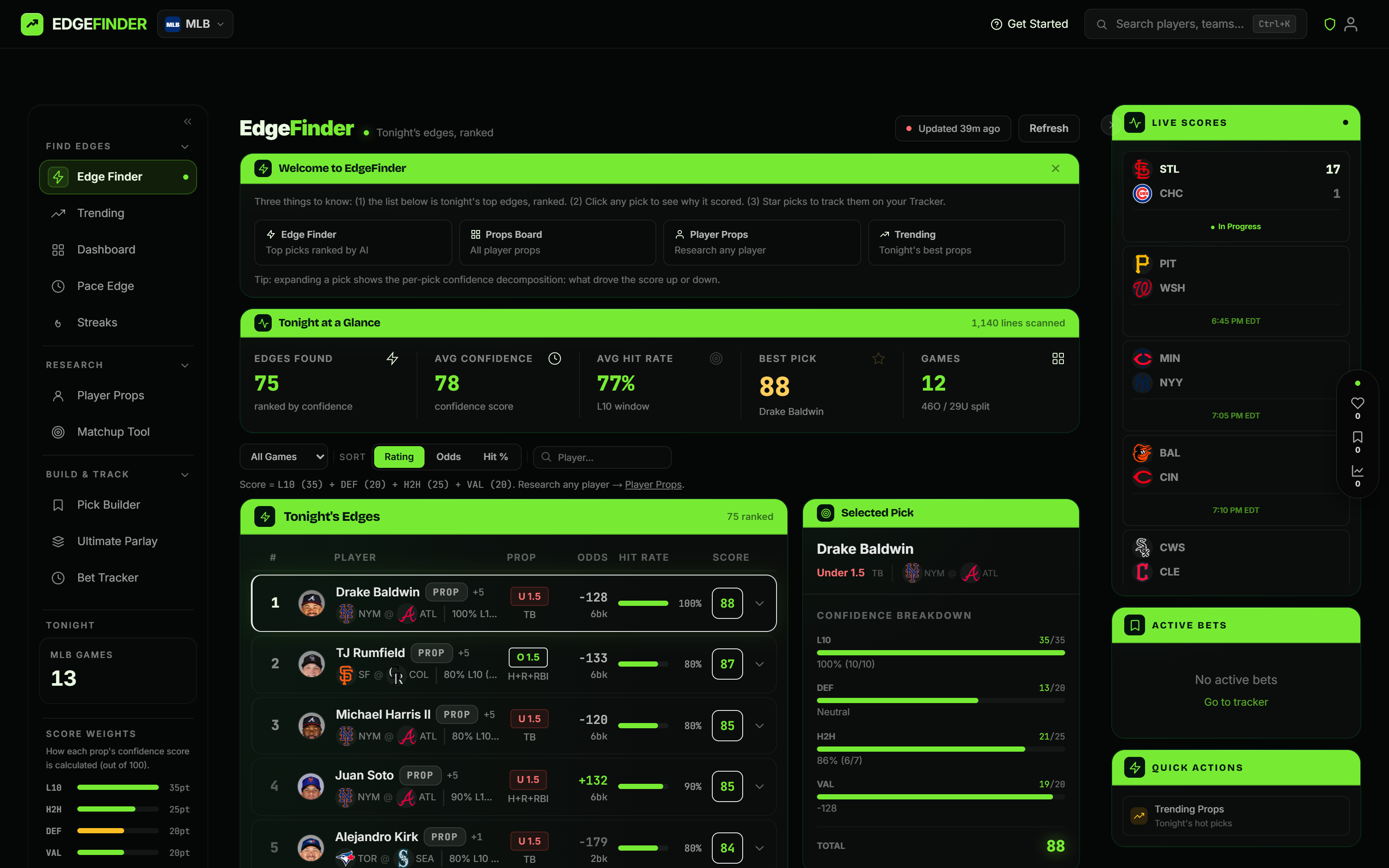
Everything above answers one question: is this bet worth more than it costs? A strong hit rate, a clean log, a soft matchup and the best available price only matter if they add up to positive expected value: the price you are getting is longer than the true odds of the thing happening.
That is the whole game: passing on the props that are priced fairly and only firing on the ones that are not. EdgeFinder does this math for every prop on the slate and flags the ones where the number is off.
The market prices this at 44.6%. The sharps make it 49.5%. That gap is your edge.
Hit rates, game log, matchup, line, edge. Running that read by hand for one player takes a few minutes. Running it for every player across a twelve-game slate takes all night. EdgeFinder does the entire read for you: every prop scored, game logs graded, lines shopped, and the strongest edges surfaced on top.

Work through five steps in order: check the player's hit rate across multiple windows (last 5, 10, 15 games and the full season), read the actual game log for consistency and outliers, adjust for tonight's matchup (how the opponent defends that position, head-to-head history, and pace), shop the line and price across every sportsbook, and only bet when the best available price is longer than the true odds of the outcome, a positive-expected-value edge.
There is no universal cutoff, because a hit rate only means something next to the price. A prop that hits 60% of the time can still be a bad bet if the book charges you as if it hits 70%, and a 52% prop can be a great bet if it is priced like a coin flip. Use hit rate to find candidates, then compare it to the odds to find the actual edge. Consistency across windows matters more than a single hot streak.
Minutes and role come first. A player cannot produce if he is not on the floor, so usage and rotation context sit above everything else. After that it depends on the prop: points track shot volume and pace, rebounds track the matchup and how many shots go up, assists track on-ball role and how well teammates finish. Always read the counting stat in the context of how it is actually generated.
Because the same prop is rarely priced the same everywhere. One book might post the line half a point higher than another, and prices can swing meaningfully on identical bets. On props those gaps are large relative to your edge, so taking the best number and the best price is one of the easiest, most repeatable ways to add value.
Yes, and it is one of the biggest factors. When a teammate sits, usage shifts. The player who inherits those minutes and touches sees his realistic range jump, while season averages built with the full rotation understate him. Always check who is in and who is out tonight before trusting a historical hit rate.
Yes. EdgeFinder runs this exact method across every player on the slate: hit rates by window, graded game logs, matchup and pace context, and live line shopping across the major books. It then scores each prop and surfaces the ones with a real edge. You can also research any single player yourself with the interactive prop research tool.
Start your free trial and get the full method on every player, every prop, every game: hit rates, game logs, matchups and live line shopping in one place.
Start Free Trial21+ only · Informational purposes only · Not gambling advice · Gamble responsibly · 1-800-522-4700 · ncpgambling.org